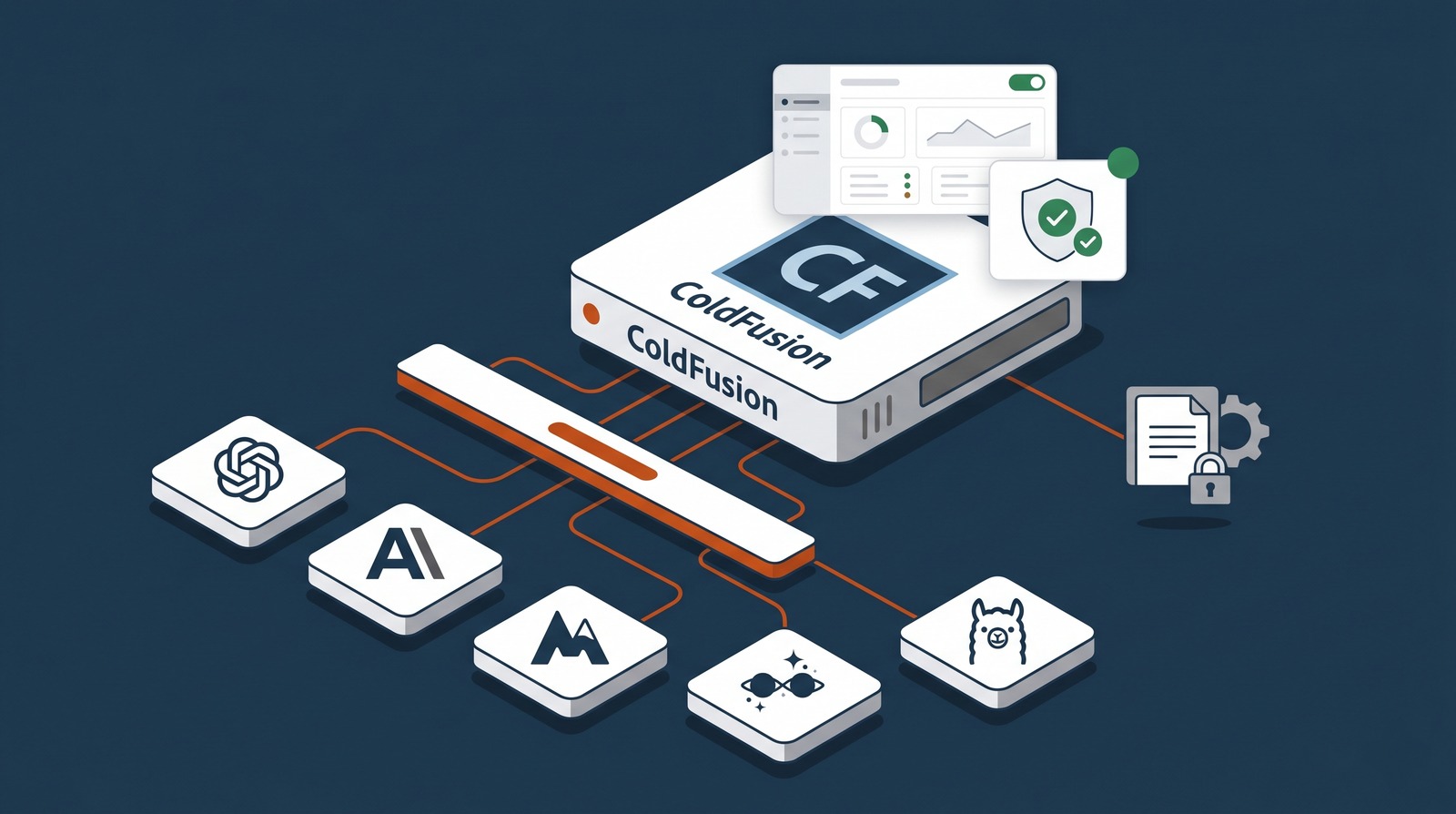
If your business runs on a ColdFusion application, the platform underneath you just changed in ways that matter to the executive team, not only the engineering team. Adobe's recent Update 8 release adds native AI, an open-standard protocol for AI agents to safely interact with your application, a built-in retrieval pipeline for grounding answers in your own documents, and a security and monitoring layer built specifically for AI workloads. All as an in-place update. No rebuild required.
For owners, CEOs, COOs, and product leaders, that release reframes a conversation a lot of you have been quietly avoiding. It is no longer "do we need to replatform the CF application to compete with AI-native vendors." It is "what is the smallest meaningful AI capability we can ship inside the application we already have, and who do we trust to lead that decision?"
The technology side of that question has answers. The leadership side, for most businesses in the $5M to $50M range that own a CF application, does not. The rest of this is a CIO's read on what actually shipped, what it means for your business, and where the decision-making gap usually shows up.
What actually shipped in Update 8?
The release announcement covers six capability areas. In plain English:
Native AI integration across the major model providers. ColdFusion now has built-in functions for talking to AI models from OpenAI, Anthropic, Mistral, Google Gemini, and Ollama, all sitting behind a single unified abstraction. Switching from one provider to another is a configuration change, not a code rewrite. Your business is not stranded if your AI vendor changes pricing or terms.
Model Context Protocol (MCP) as client and server. MCP is the emerging open standard for how AI agents discover and use external tools. Your application can now publish a defined set of tools that an AI agent is allowed to call, and your application can also reach out to other MCP-published tools. The practical effect is that AI integration moves from "we wired a chatbot to our API and hoped" toward "we have a controlled contract that lets agents do specific things and nothing else."
Vector stores and native RAG. Update 8 ships a retrieval-augmented generation pipeline with five vector store options and three levels of control. Translation: you can take your own documents, policies, manuals, contracts, knowledge base, and turn them into a semantic search layer that grounds AI responses in what your business actually says, instead of in what the model thinks it remembers.
Security built for the new attack surface. Native passkey support (WebAuthn/FIDO2) for passwordless sign-in, an Argon2 default for password hashing, an expanded Security Analyzer with PDF and CSV exports, and AI-specific guardrails that let you filter both inputs and outputs before they reach the model.
A modernized developer surface. The ColdFusion Builder VS Code extension picks up Linux and Docker as first-class targets, gains AI-aware code completions, and improves the Security Analyzer. This is the boring item on the list and also the one that most determines how fast a team can actually adopt the new capabilities without making expensive mistakes.
AI services monitoring inside the Performance Monitoring Toolkit. A new AI Services dashboard with full visibility into LLM calls, agents, RAG pipelines, MCP clients and servers, vector stores, and a trace viewer that shows the full flamegraph of each AI request. You can see what AI is doing, what it cost, and where it is slow. This is the difference between AI as a science experiment and AI as a production system you can defend in front of your board.
Underneath those is a meaningful set of language and performance updates that engineers care about and most business stakeholders will never have to. The headline shift is the AI work.
Why does this matter if my application is already running fine?
A platform that is "running fine" today is silently widening the gap between what it does and what your competitors' platforms are starting to do. Six months ago, "we will add AI later" was a defensible position. Today, it is a position that requires a thesis. Update 8 changes the business math in four ways worth pausing on.
You do not have to rebuild. The AI features sit inside the same platform your team already knows. Adding a document-grounded knowledge assistant, an internal copilot, or an AI-augmented workflow becomes a feature project, not a platform migration. The cost of entry is the cost of designing and building the feature, not the cost of replacing the foundation.
You are not locked into a single AI vendor. The unified provider abstraction is not a small detail. It is a hedge against the most predictable risk in the current AI market: the vendor you pick today will change pricing, change terms, or get acquired tomorrow. With Update 8, swapping providers is a config change. You can negotiate, you can test alternatives, and you can survive your provider doing something unfriendly.
Your data does not have to leave the building. RAG against your own documents means the AI's answer is grounded in your content, not in whatever the model picked up during training. For businesses in regulated industries, or for any business with proprietary process knowledge, this is the only AI pattern that survives a serious privacy or compliance review.
Governance is finally built in. Guardrails, monitoring, audit trails, and a structured protocol for what AI agents are allowed to do are now first-class features of the platform. You can ship AI capabilities with a real story for how you control them, instead of explaining to your auditor that you trust the model to behave.
The combined effect is that a ColdFusion application that looked like a maintenance liability six months ago is now a credible foundation for AI capabilities competitors will spend the next year trying to bolt onto theirs. That is a competitive window most CF-based businesses do not realize they have.
What this looks like from the business side of the table
If you are the owner, CEO, COO, or head of product, the questions in front of you are not technical questions. They are leadership questions that the technology now supports almost any answer to. The risk is making the wrong call quietly, by default, while the platform's new capabilities sit unused.
These are the questions actually on your plate.
Where in our business would AI create real value, and where would it create noise? Customer service response time, sales enablement, internal knowledge lookup, document review, training, onboarding, compliance triage. Some of those are AI gold for your specific business. Others are demo-friendly and adoption-flat. Picking the right ones requires knowing your business well and knowing the technology well enough to see what it can actually do.
What is our AI vendor and data posture? Do we start with OpenAI or Anthropic or a self-hosted model? Where does customer data, employee data, and regulated content live in that pipeline? What happens if our preferred vendor changes terms? These are governance questions with cost and risk implications. The platform supports the answer; you have to choose it.
How will we measure what this costs? AI calls are not free, and unmanaged AI usage scales cost faster than most owners expect. The monitoring layer is now there. Someone has to wire it into your finance and operations reporting before usage scales, not after.
Where do we need human-in-the-loop checkpoints? Which AI outputs touch customers directly? Which ones get reviewed first? Who is on call if an AI response misbehaves in front of a customer or a regulator? The technology supports the controls. The controls only work if a human owns them.
Who is leading this decision for us? This is the one most owners do not want to ask, because the honest answer for most CF-based businesses is "nobody, yet." Your senior developer is not automatically a senior AI strategist. Your product manager may not have the platform context. Your offshore vendor will execute against any brief you give them and will not push back on the brief. The decision about which AI capabilities to build, in what order, with what guardrails, and at what cost is an executive decision. If you do not have a CIO or CTO on staff, the decision is currently being made by default, which is the most expensive way to make it.
Where are the real risks?
Four worth naming directly.
The skills gap, in both directions. A senior ColdFusion developer is not automatically a senior AI engineer. A senior AI engineer is not automatically a senior CF developer. The platform makes the integration easier; it does not make the architectural and product decisions for you. Teams that treat Update 8 as "we already know CF, so we know this" tend to ship AI features that work in the demo and embarrass the business in production.
Choosing the wrong first use case. The easiest mistake is to start with the use case that looks impressive in a board meeting rather than the one that quietly compounds value over time. A document-grounded internal knowledge assistant is rarely impressive. It is almost always the highest-ROI starting point. The mistake of starting with the flashy use case has cost more businesses more money than any technology choice in the last three years.
Treating governance as a technology problem. AI guardrails and monitoring are necessary, not sufficient. The judgment about what the AI is allowed to do, when it must escalate, and how exceptions are reviewed is an executive decision that has to be made before the code gets written. We have written before about why this is a systems-thinking problem rather than a prompt-engineering one.
Underestimating the operational lift. Running AI in production looks like running any other critical service in production. It needs monitoring, alerting, cost controls, rollback paths, and a release process. Update 8 gives you the tools. Your business still has to operate them, which is a function that often does not exist yet in CF-based businesses that have not had to run AI workloads before.
How does this fit a stewardship view of your software?
Every one of these decisions has long-term consequences for the business, which is why our Software Stewardship Framework treats software as something you steward across its full life rather than something you build and forget. Update 8 sharpens the cost of getting the stewardship questions wrong.
The engineering decisions (which provider, which vector store, which RAG pattern) lock you into operational and vendor consequences for years. The security decisions (where data flows, how guardrails are reviewed, how access is controlled) protect or expose the trust your customers and regulators have given you. The quality decisions (how you test AI behavior, how you monitor what it actually does in production) determine whether your business has a defensible story when something goes wrong. The product decisions (which AI capabilities to build, for which users, in which order) decide whether your business gets paid back on the investment.
These are not engineering line items. They are executive decisions, each one with a long tail. Update 8 made the technology to support any of them easier. It did nothing to make the executive judgment behind them easier. That part is still on your leadership team.
What should you do next?
If your business runs on a ColdFusion application, the right next step is not a long study. It is a tight discovery conversation that answers three questions: where AI would actually move the needle for your specific business, whether your current CF environment is ready to absorb Update 8 cleanly, and what the smallest meaningful first AI feature looks like. From there, the right people can implement it inside your existing application without disrupting the work that pays the bills.
That conversation is the kind of work a fractional CTO or CIO is built for. You get an experienced technology executive in the room for the decisions ahead of you, without committing to a full-time hire before you know whether one is warranted. Paired with engineers who actually know the platform you run on, it is the difference between adding AI as a thoughtful addition to your business and adding it as a line item nobody on your team is qualified to own.
PALADEM has ColdFusion specialists on the bench and provides fractional CTO and CIO leadership for the decisions that come before the code. The strategy work and the build work share one accountable relationship, which is the only model where this kind of release becomes a real competitive advantage instead of a six-month consulting bill.
If you own or run a business with a CF application, and you want to know what Update 8 means for your specific environment, the discovery conversation is the call.