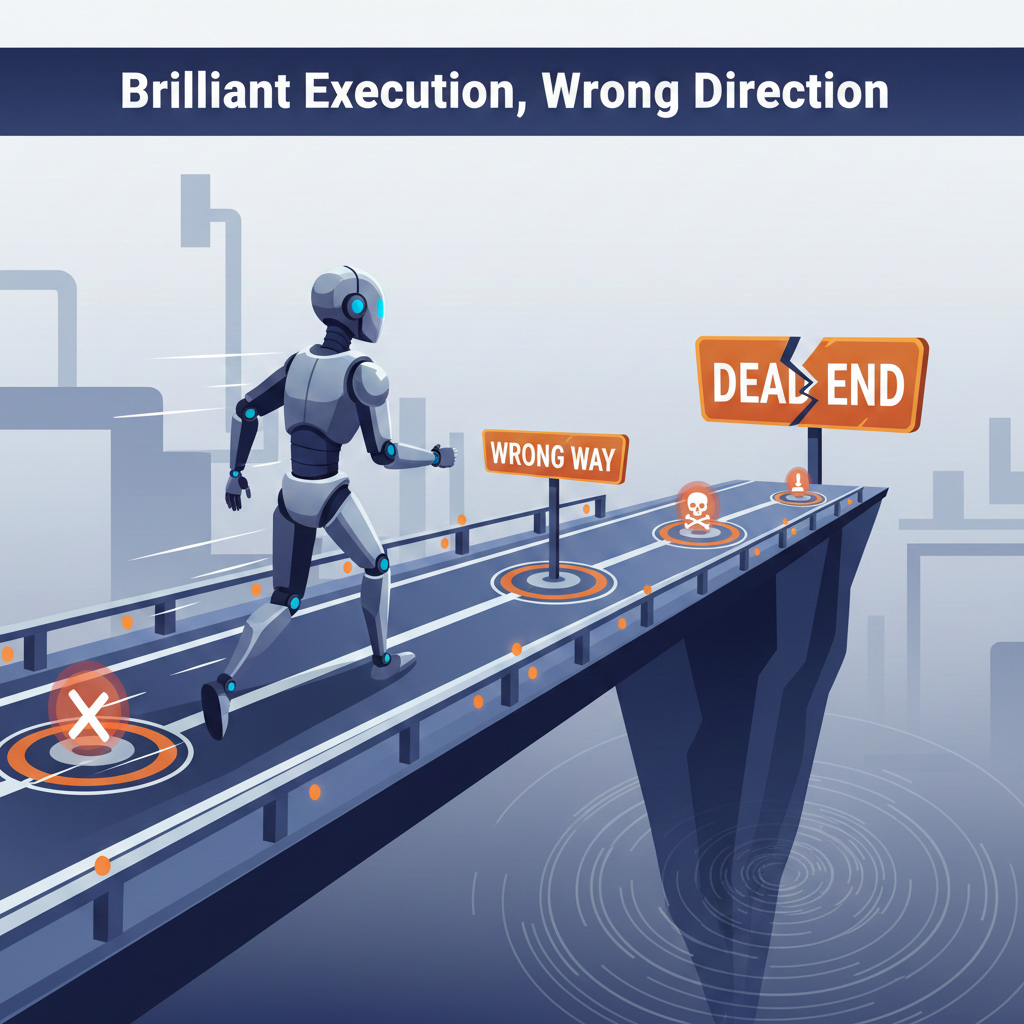
Give an AI agent a well-defined task and it'll execute flawlessly, tirelessly, at scale. Expect it to question whether that task should be done at all? Don't hold your breath.
We're implementing agentic AI solutions for clients and seeing this pattern consistently. The agents are incredible at following the process, optimizing within constraints, and producing derivative work. But they fundamentally lack the ability to step back and ask "is this the right approach?" so they never challenge assumptions embedded in their instructions. They are also incapable of the human inspiration and ingenuity required to generate truly novel ideas.
This isn't a flaw... it's their nature. And it means the quality of your agentic AI output is directly proportional to the quality of your guardrails.
We've inherited a few "vibe-coded" applications that turned into spaghetti code because no one established architectural guidelines. The AI coding tools took different approaches between sessions... because why wouldn't they? There were no standards to follow, so they picked whatever seemed most efficient for that individual task... lacking the context to consider the long term effects of those choices.
It's like hiring a brand new contractor every time you want to make a small change to your application. Each one comes in with their own approach, their own patterns, their own interpretation of "best practices." Without standards, they just do whatever they think is right.
The result? Technical debt that compounds with every session. Code that works but can't be maintained. Applications that become progressively harder to modify.
What Guardrails Actually Look Like
Build in mandatory checkpoints where agents must surface their reasoning and pause for human review before proceeding. Not at the end when you've already gone miles down the wrong path... at decision points.
Establish clear standards and best practices that persist across sessions. Agents have no institutional memory between invocations. If your quality standards aren't explicit and consistent, you'll get wildly different outputs depending on how the agent interprets context.
Define the boundaries where the agent must stop and escalate. Know the limits of execution vs. strategy. Agents shouldn't be making strategic choices... they should be executing strategic choices humans have made. This is true whether the agent is working inside a codebase, triaging back-office documents, or answering the phone: an AI voice agent with unclear escalation rules is just as capable of confidently shipping the wrong outcome as any other kind.
Systems Thinking Over Prompt Engineering
The real skill in agentic AI isn't prompt engineering... it's systems thinking.
You need to architect the decision flows, define the quality gates, and determine where human judgment is non-negotiable. The agent is a powerful tool, but someone with actual critical thinking skills needs to design the system it operates within. This is where our Software Stewardship Framework earns its keep: the engineering, quality, and operational pillars are exactly the rails that keep an agent from quietly accumulating the kind of technical debt that takes years to unwind.
Otherwise, you're just automating your way down the wrong path faster.