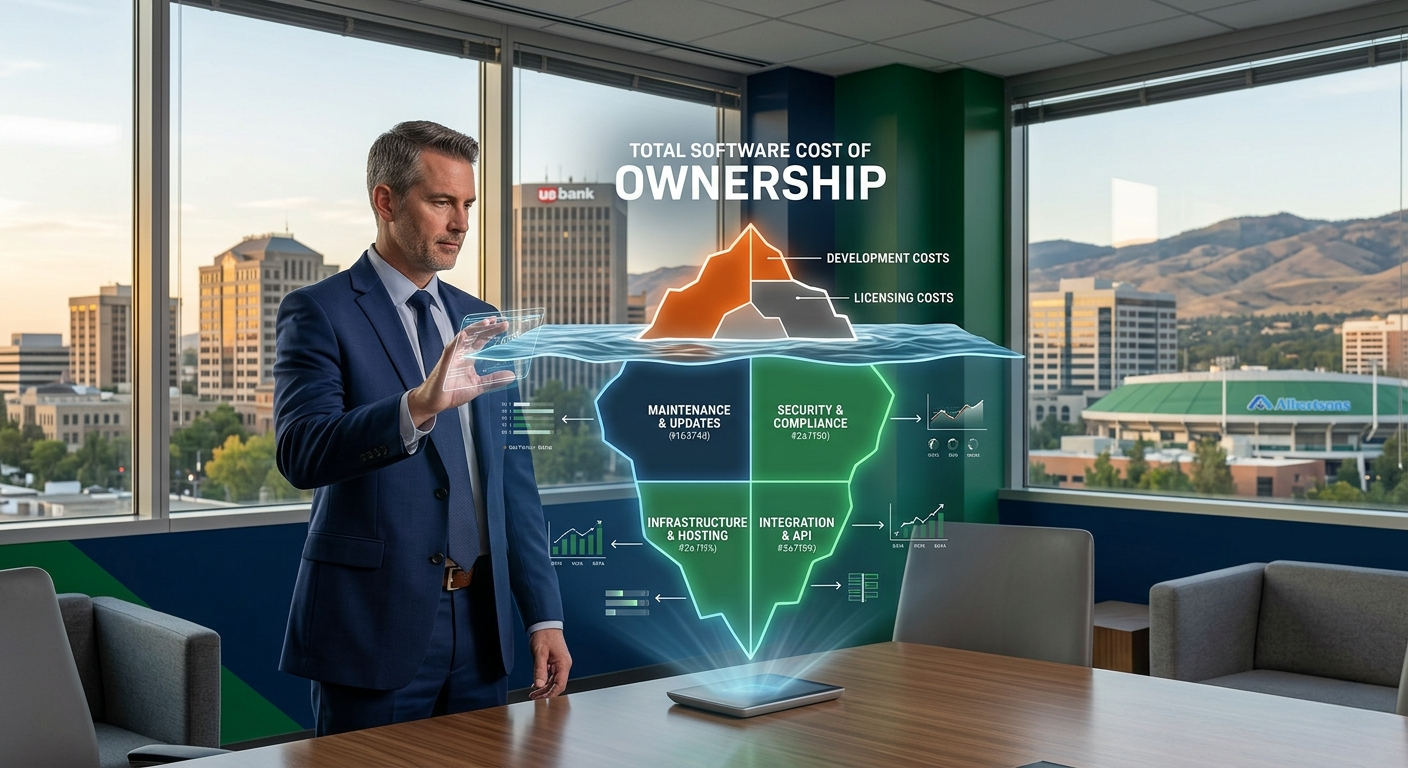
I was talking to some colleagues recently about a pattern we keep running into. Organizations make a major software decision, hit go-live, and then six to twelve months later are surprised by what the system actually costs to run. The procurement budget was a few hundred thousand dollars. The first year of operations is somehow another few hundred thousand dollars. Year two is more. Year three is a lot more. By year four someone is asking if it might be cheaper to start over.
Here is the uncomfortable truth about software projects. Most of them do not fail during development. They fail after they are delivered. The expensive part of software is not building it. It is owning it for the next decade.
This article is about how to see those costs before you commit to them, instead of after.
What Total Cost of Ownership Actually Includes
When most teams talk about the cost of a software system, they are talking about the build cost or the license cost. That is the visible piece. It is the part that shows up in the procurement document, the part the CFO signs off on, and the part the project plan tracks against.
The much larger piece is everything that happens after launch. A reasonable list of what you are actually buying when you commit to a new system looks like this.
- Maintenance. Bug fixes, dependency updates, library upgrades, the steady stream of small repairs that keeps a system from drifting out of working order.
- Security updates. Patches for the operating system, the language runtime, the web framework, every third-party library, and every dependency of those libraries. This work never ends, and it is not optional.
- Integrations. The connections between this system and every other system in your business. Each one of those connections is a relationship that can break when a partner updates their API, changes a data format, or migrates to a new version.
- Infrastructure. Servers, cloud services, database hosting, storage, backup, monitoring, all of which have monthly bills that almost always trend upward as the business grows.
- Operational support. The people on call when something breaks at 2 a.m. The people who handle production issues during business hours. The people who respond to internal user questions.
- Engineering effort to keep the system aligned with the business. Every time the business adds a new product, enters a new market, signs a new compliance commitment, or changes a workflow, somebody has to update the system to reflect that. Over a decade, this is often the single largest cost line.
- License renewals and price increases. Vendors raise prices. Tiers change. Features that used to be included get moved into premium plans. Year one cost rarely looks like year five cost.
- Training and documentation. The cost of keeping users productive, especially as staff turns over and the original users move on.
- End-of-life and eventual replacement. Every system you commit to today is one you will eventually have to retire or replace. That cost is real even if it is far away.
That list is not theoretical. It is what every running system in your business is costing you right now, whether or not anyone is tracking it.
Why "Cheaper" Upfront Is So Often the Most Expensive Option Long-Term
The phrase that keeps coming up in procurement conversations is "we got a great deal on the upfront cost." That sentence should be a yellow flag, not a green one. Here is why.
A vendor who is willing to price aggressively to win the deal is rarely doing it out of generosity. They are usually planning to recover the discount somewhere else. Sometimes that is in premium support contracts. Sometimes it is in integration fees. Sometimes it is in license tier changes that move features you assumed were included into a paid add-on. Sometimes it is in implementation services that turn into multi-year engagements because the platform is harder to configure than the demo suggested.
A custom build that came in under budget is often hiding the same kind of problem. The way custom projects come in under budget is by deferring work that does not feel essential at launch. Security hardening. Scalability testing. Observability. Documentation. Automated testing infrastructure. All of those feel like nice-to-haves when the deadline is two weeks away, and all of them get cut. The bill arrives later, sometimes in the form of a security incident, sometimes in the form of a production outage, sometimes in the form of an engineering team that cannot safely change the system because there are no tests to catch regressions.
A vendor that "looks cheaper" or a build that came in "under budget" should always trigger the same follow-up question: what was traded away to get there? If you cannot answer that clearly, the cost is hiding somewhere and you will find it later.
The Questions Great Stewards Ask
The job of a technology steward, whether that is a CIO, a fractional CTO, an engineering leader, or an outside advisor, is to ask the questions that the procurement process tends to skip. There are five of them I keep coming back to.
1. How Will This System Scale?
Not "can it handle today's load." Today's load is solvable on almost any modern platform. The real question is how it scales as the business grows by a factor of three, five, or ten. Where do the bottlenecks appear? What does the price curve look like as you grow? Are there architectural ceilings that will require a major migration before you hit your three-year revenue plan?
2. What Does it Cost to Maintain in Steady State?
Not the year-one cost when the vendor is being attentive and the implementation team is fresh. The boring year-three cost, when the system is running quietly and somebody is paying the monthly bill without thinking too hard about it. That number is the real total of operational cost, and it is the number you should be using to compare options.
3. Who Will Own This After Go-Live?
A system without a clear owner is a system that decays. "The team that built it" is usually not a sustainable answer, because that team eventually moves on. "Operations" is usually not specific enough. The good answer names a person or a small group with explicit accountability for the system's health, including the budget to invest in keeping it healthy.
4. What Operational Risks Does This System Create?
Every system carries risk. Some of the risks are obvious (data loss, security breach, downtime during peak traffic). Some are more subtle (vendor lock-in, dependency on a single team member, regulatory exposure as compliance requirements evolve). A good evaluation surfaces the operational risk profile before the contract is signed, not after.
5. What Is the Incremental Modernization Strategy?
This is the question that almost no procurement process asks. Every system you commit to today will need to evolve over its lifetime. What is the plan for that evolution? Is the platform extensible? Is the codebase maintainable? Is there a roadmap for keeping the system aligned with the business as both change? Or are you committing to something that will be a replacement candidate in five years because nobody planned for the steady-state work of keeping it healthy?
We have written more about the mechanics of modernizing software systems incrementally in a separate article. The point here is that thinking about that work in advance, before the system is even live, is a sign of good stewardship. Skipping it is how organizations end up replacing five-year-old software with another five-year-old replacement candidate every cycle.
The Goal is a Long-Term Asset, Not an Aging Liability
Here is the thing that gets lost in most procurement conversations. The goal of a software investment is not just to deliver a working solution. It is to ensure that the solution remains a long-term asset, not an aging liability.
That distinction matters because the actions you take during procurement, design, and early operations either set the system up to age well or set it up to age badly. Building in observability, automated testing, documentation, and a maintenance budget on day one is dramatically cheaper than retrofitting all of that under pressure two years later. The teams that get this right are the ones who treat the system as something they will own and care for over a long horizon, not as a project that ends at go-live.
The Software Stewardship Framework PALADEM works from is built around this idea. The Product, Project, Engineering, Quality, Operational, and Business Stewardship pillars all contribute to the long-term cost picture, and weighing decisions against all of them is what keeps a working system from quietly turning into next year's replacement candidate.
Great stewards consider the cost of tomorrow, not just the cost of today. The discipline of asking the questions above, before the budget is committed, is what separates a software investment that compounds over a decade from one that becomes a recurring expense the business never quite gets ahead of.
Why PALADEM?
PALADEM has spent more than 26 years stewarding software for organizations including Thomson Reuters, Best Buy, See's Candy Shops, Hilton, Westin, AAA, and Yamaha Music, plus a wide range of small and mid-sized businesses. Most of those engagements have involved at least one moment when a TCO conversation changed the direction of a project, sometimes saving years of operational cost, sometimes preventing a build-versus-buy decision that would have looked good on the quarter and bad on the decade.
If you are looking at a major software decision and want a candid view of what it is going to cost to actually own, start a conversation. We will help you put the long-term cost on the table while you can still do something about it.