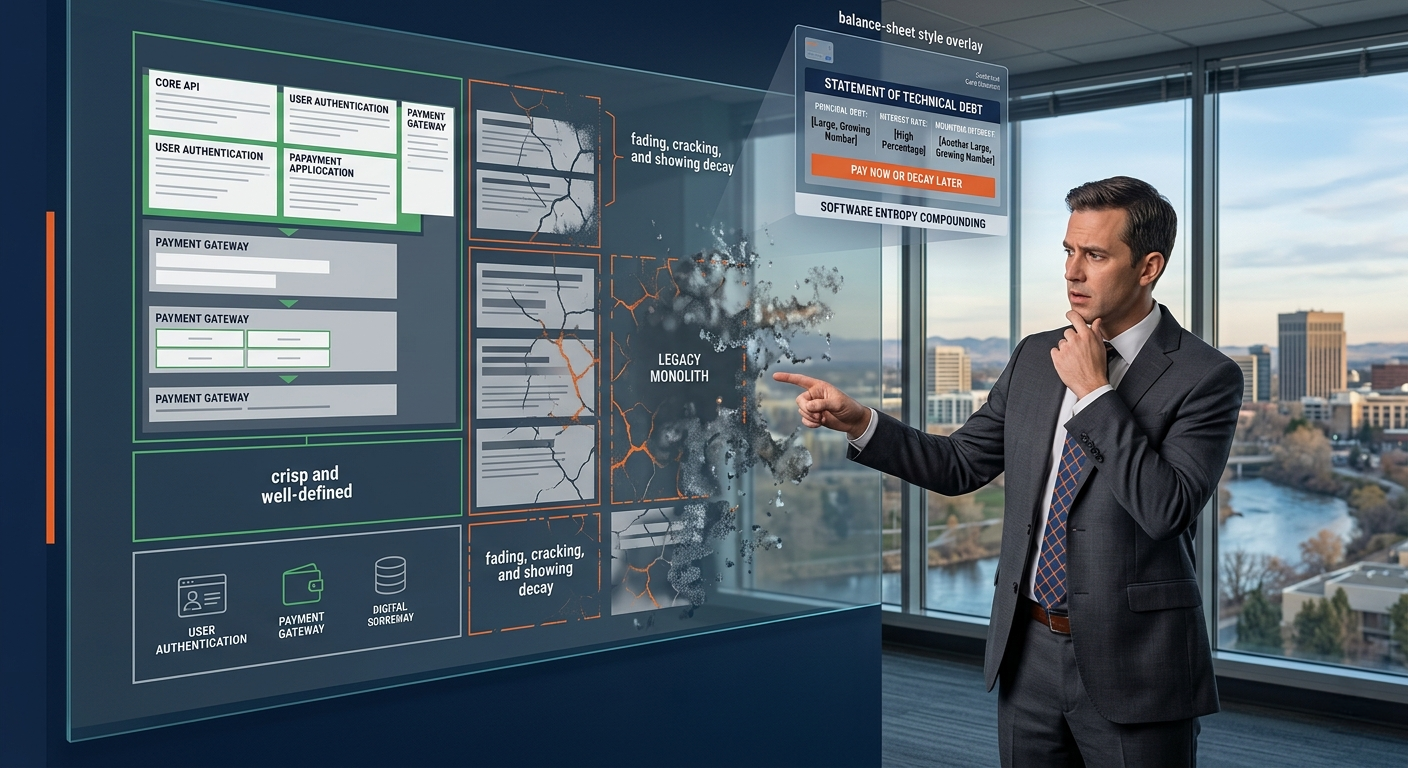
I have seen organizations spend millions on "modernization" projects that never quite finish. Years go by. Budgets are renewed. Roadmaps are adjusted. Meanwhile, the legacy system that was supposed to be replaced keeps running, accumulating technical debt like interest on a loan nobody wants to pay off.
This pattern is so common that it deserves a name. It is what happens when an organization tries to solve software entropy with a single big project, and discovers too late that the project itself is making the entropy worse.
This article is about why that happens, what software entropy actually is, and the alternative approach that prevents the crisis instead of producing it.
What Software Entropy Actually Is
Software entropy is the natural tendency of code to decay over time. It is not a bug, and it is not the result of bad engineering. It happens to every codebase, including codebases that nobody is actively changing, because the world around the code keeps moving even when the code does not.
The mechanisms are familiar to anyone who has owned a system for more than a few years.
- Dependencies drift out of date. Every library, framework, and platform you rely on releases new versions, deprecates old features, and eventually drops support for older releases. If you are not regularly updating, you are accumulating an upgrade backlog that gets harder to clear with every quarter that passes.
- Architectural patterns that were cutting-edge become liabilities. The architectures that defined "modern" software ten years ago, monoliths with stored procedures, server-side rendered pages, single-region deployments, are not wrong, but they impose constraints that newer architectures do not. The longer you wait to address those constraints, the more code you have written on top of them.
- Knowledge walks out the door with retiring or departing developers. Every engineer who leaves takes a portion of the system's institutional memory with them. Some of it is documented. Most of it is not. The buried business logic from twenty years of edge cases lives in their heads, and when they go, the cost of changing the system goes up.
- Operating environments change. Browsers update. Mobile platforms release new versions. Operating systems deprecate APIs. Each of those changes can break assumptions your code was built against, and each one demands a small adjustment that becomes a much bigger adjustment if it is deferred long enough.
- Security vulnerabilities accumulate. New vulnerabilities are discovered every month in libraries you depend on. Each one needs to be evaluated, patched, and deployed. The cost of falling behind on this is not just operational; it is regulatory and reputational.
None of these things require anyone to touch your code. But each one makes the code harder, slower, and more expensive to safely change tomorrow than it was yesterday. Without a deliberate strategy to counter the entropy, every day your system exists, it becomes a little harder to work with.
Why "Rip and Replace" Paradoxically Accelerates Entropy
The instinct, when an organization finally notices the decay, is to do something dramatic about it. A new platform. A clean architecture. A greenfield rewrite. The pitch sounds compelling: instead of paying down decades of debt one quarter at a time, we will replace the whole thing and start fresh.
The problem with this instinct is that it makes the entropy worse during the transition, not better. Here is the failure mode I have watched play out repeatedly.
The moment leadership commits to a big-bang replacement, the team responsible for the legacy system gets a quiet message: this system is going away, so do not invest too much in it. The reasoning sounds rational. Why spend money maintaining something we are about to retire? Why update dependencies on code that will not exist in eighteen months? Why refactor or document a system that is being replaced?
So maintenance slows down. Then it stops. Then the legacy system, which is still running production, starts degrading faster than it was before, because the small ongoing investment that was previously keeping its decay in check has been redirected to the new project.
Meanwhile, the new project is taking longer than expected. Big-bang rewrites routinely come in at two to four times their original timeline, because the team building the new system runs into all the buried business logic in the old one and has to rediscover, re-validate, and re-implement decisions nobody documented. By the time the rewrite is done, or canceled, two things have happened. The legacy system is in dramatically worse shape than it was at the start. And the organization has spent its modernization budget without producing the modernization.
The very act of planning a big-bang modernization can paradoxically accelerate entropy in the current system, because it changes the incentive to maintain it. That is the trap.
The Credit Card Analogy
I find the easiest way to explain this to non-technical leadership is with a credit card analogy. Software entropy is interest, not principal.
If you have a credit card balance you could have paid off in twelve to eighteen months by allocating an extra hundred dollars a month, you are in one situation. You can keep that situation under control with a steady, modest, ongoing investment. The math is in your favor.
If you only make the minimum payment for five years, the situation is entirely different. The interest has compounded. The balance is now a problem requiring a debt consolidation loan, a payment plan, or some other dramatic intervention. The math is no longer in your favor.
Software is the same. A codebase that gets a small, consistent investment in dependency updates, refactoring, automated testing, and documentation stays manageable indefinitely. A codebase that only gets the minimum required to keep the lights on accumulates entropy until it requires a multi-year rewrite to recover.
The decision point is not "rewrite or not." The decision point is "are we making the small ongoing payments, or are we accumulating interest until the bigger reckoning is unavoidable?" The cheaper path requires more discipline up front, and it never produces a crisis dramatic enough to make a board presentation about. That is exactly why so many organizations skip it.
What Incremental Modernization Actually Looks Like
The alternative to big-bang modernization is the systematic, ongoing investment in keeping your software healthy through continuous small improvements. None of these patterns is dramatic. Together, they are how you prevent the crisis from forming in the first place.
The Strangler Fig Pattern
Named after the strangler fig tree, which grows around an existing tree and gradually replaces it, the strangler fig pattern is the canonical approach to incremental modernization. New functionality is built in modern architecture around the legacy system. Over time, more and more requests are routed to the new components. The legacy system shrinks. Eventually, what is left of it is small enough to retire safely, or even to leave running indefinitely if it is still doing something useful. There is no big-bang cutover. The transition happens one well-defined slice at a time.
This pattern works because it never puts the business in the position of "the new system is not ready yet, so we cannot turn off the old one." Both systems run together for as long as needed, and the migration progresses at a pace the business can absorb.
Targeted Refactoring Tied to Business Deliverables
Refactoring as a side project rarely survives the first quarter where the business has a real priority. Refactoring tied to feature work almost always survives, because it is paid for by the feature.
The pattern looks like this. When the business asks for a new feature in a particular subsystem, the engineering team uses that opportunity to also clean up that subsystem. Better naming, better tests, better separation of concerns, better documentation. The feature ships, and the subsystem is in better shape than it was before. Over time, the subsystems most actively used by the business become the cleanest parts of the codebase, while the dead code that nobody is touching can be safely left alone.
This approach is not as satisfying as a top-down architectural refactor, but it is dramatically more likely to actually happen, and it produces durable results because the cleanup is happening exactly where the business is investing.
Automated Testing as a Safety Net for Change
Every modernization investment should leave behind better test coverage than it found. Tests are what make the next round of changes safe and fast. A codebase with no tests is a codebase where every change is dangerous, which means every change is slow, which means the engineering team has every incentive to make as few changes as possible, which is exactly how entropy compounds.
Investing in test coverage as part of every modernization slice is one of the highest-leverage moves available. It compounds in the right direction: the more tests you have, the safer changes are, the more changes you can make, the more entropy you can keep clearing.
Dependency and Security Hygiene as a Standing Investment
Most software entropy lives in the gap between the dependencies you have and the dependencies you should have. A small, ongoing investment in keeping that gap small (regular dependency updates, automated security scanning, a habit of staying within one or two minor versions of current) prevents the much larger investment of catching up after years of deferral.
Treat this as a standing budget line, not a project. The teams that get this right have a regular cadence (weekly or monthly) where dependency updates and security patches are evaluated, applied, and tested. The teams that get this wrong defer the work until a security incident or a vendor end-of-life forces it.
When Replacement Really Is the Right Answer
To be fair to the rip-and-replace instinct, there is one situation where it is genuinely the right answer: when the underlying technology stack is dead.
If your system is built on a language or framework that is no longer being actively developed, where vendor support has ended, where security patches have stopped, and where the talent pool to maintain it has evaporated, you are not really choosing between rewrite and modernization. You are choosing between rewrite and accepting compounding risk that the system will fail at the worst possible moment with no path to recovery.
In that scenario, a full rewrite is the responsible call. But it is a different problem than software entropy, and it is rarer than most organizations think. Outside of that specific situation, incremental modernization wins almost every time. We have written more about the broader question of when to rewrite versus modernize in a separate article, and about whether the system is really the problem at all in another.
What's Your Software Doing Right Now?
The hardest part of fighting software entropy is that the work is invisible until you stop doing it. Nobody notices that dependencies are up to date, that test coverage is healthy, that security patches are being applied on a regular cadence. The signal that the work is being done is the absence of crisis.
That is why so many organizations end up in a "modernization project" instead of a modernization practice. The crisis-free state does not generate a board agenda item. The crisis state does. By the time leadership is paying attention, the entropy has compounded to the point where dramatic intervention feels like the only option, even though the cheaper path was always available.
If you are running a system that has not been getting the steady-state investment, the right move is not to launch a big modernization project. The right move is to start making the payments now: stabilize what is working, identify the highest-risk subsystems, set up a cadence for dependency and security work, and tie refactoring to actual feature delivery. Within a couple of quarters, the trajectory of the system changes. Within a couple of years, the system that looked like a replacement candidate is healthier than it was a decade ago, and the business has spent a fraction of what a rewrite would have cost.
Why PALADEM?
PALADEM has spent more than 26 years stewarding software for organizations including Thomson Reuters, Best Buy, See's Candy Shops, Hilton, Westin, AAA, and Yamaha Music, plus a wide range of small and mid-sized businesses, often coming in to help leaders decide whether the right answer is to modernize, to rewrite, or to leave alone. The Software Stewardship Framework we work from is built specifically to keep these decisions deliberate, the entropy under control, and the modernization investment tied to business outcomes that compound over time.
If you are looking at a system that has been accumulating decay and trying to decide what to do about it, start a conversation. We will help you put the right kind of payments in place before the bigger crisis develops.