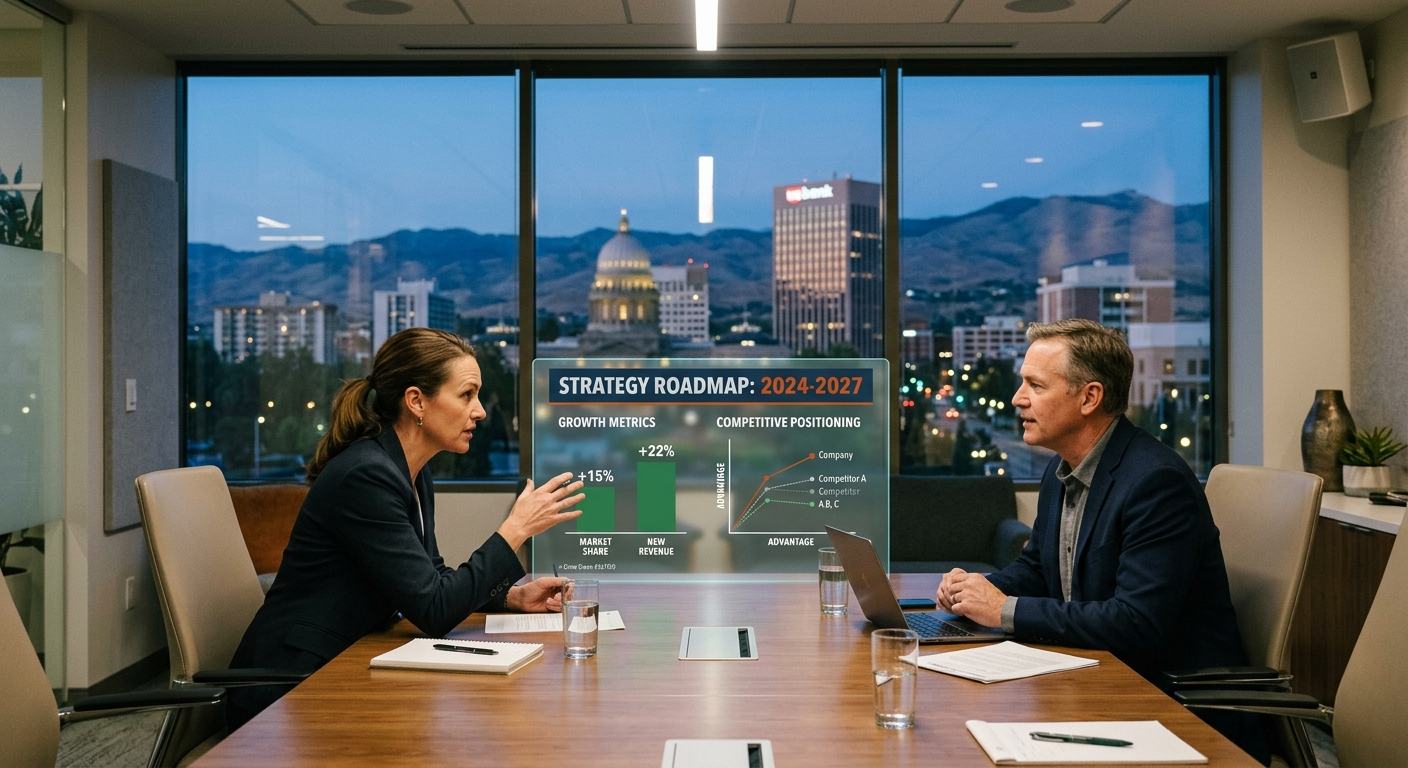
If you run a business, you already know your IT department has a budget. You know roughly what it costs. You have probably been in at least one quarterly meeting where someone tried to convince you that the budget needs to go up, and you almost certainly have a default reaction to that conversation that is shaped less by the merits of the request and more by how you have been thinking about IT for the last several years.
That default reaction is the thing this article is about. Because how you think about IT, before any specific request comes across your desk, is the single biggest factor in what you actually get out of your technology investment over the next decade.
There are two ways business leaders tend to think about IT. The first treats it as overhead: a cost to be controlled, a department that says no, a budget line that gets squeezed when the business has a bad quarter. The second treats it as a strategic partner: a source of advantage, a department that asks "what are you trying to achieve" before proposing solutions, a function that influences the direction of the business rather than just the cost of running it.
Most companies are somewhere on that spectrum, and where they sit determines what kind of IT outcomes they actually get.
What Cost-Center Thinking Sounds Like
When IT is being treated as a cost center, the conversations follow a recognizable pattern.
- "How much will this cost?" is the first question.
- "Can we do it cheaper?" is the second.
- "What's the minimum we need to spend to keep things running?" is the third.
Notice what is missing from that list. There is no question about what advantage the investment creates. There is no question about what becomes possible if it is funded, or what is given up if it is not. There is no question about competitive positioning. The entire conversation lives inside the cost dimension, which means the only available outcomes are "spend less" or "spend more" with no real way to evaluate whether either is the right call.
The other tell is the kind of work IT gets. Cost-center IT is reactive. The technology team responds to tickets, fulfills requests, and keeps systems running. They are very good at the work that has been defined for them, but the work has been defined by other people. Cost-center IT does not get asked to weigh in on product strategy, customer experience, or market positioning, because the rest of the business has decided those are not technology questions.
This pattern can run for years and look perfectly fine on a quarterly review. The systems work, the budget holds, the help desk closes tickets, nothing is on fire. The cost shows up later, when a competitor with a better technology posture takes a market position your company could have taken, or when a regulatory requirement lands and your stack cannot adapt fast enough to meet it, or when an acquisition target slips away because your due diligence revealed a system you cannot defend.
What Strategic-Partner Thinking Sounds Like
When IT is being treated as a strategic partner, the conversations shift in a way that is hard to miss once you start listening for it.
- "What advantage does this create?" comes before "what does it cost."
- "How does this position us against competitors?" is on the table.
- "What becomes possible that wasn't before?" is genuinely being asked.
The technology investments that look unjustifiable under cost-center thinking often look obvious under strategic-partner thinking. Not because cost stops mattering. Cost still matters. But cost becomes one input into a more complete conversation rather than the only input. A strategic-partner relationship still says no to plenty of technology requests, and it says no for clear reasons: the request does not create advantage, the timing is wrong, the opportunity cost is too high. But it also says yes to plenty of investments that a cost-center relationship would have rejected on price alone, because the price is paying for something the business genuinely values.
The other shift is in what IT actually does. Strategic-partner IT is proactive. The technology team participates in the conversations where strategy is being shaped: product reviews, sales reviews, customer feedback sessions, competitive analysis. They bring solutions to problems other parts of the business have not fully articulated yet, because they have been close enough to those problems to see them coming. They have a real opinion on what the company should be investing in, and that opinion is informed by both the technology landscape and the business landscape, not just the technology one.
How the Conversation Is Set Up Determines the Outcome
This is the part that gets underestimated. Most business leaders assume that the way IT shows up in their organization is mostly a function of who they hired, how big the IT budget is, or whether they have invested enough in technology talent. Those things matter, but they are not the load-bearing variable.
The load-bearing variable is how the conversation about technology is set up before any specific decision is on the table. If the default conversation is "how much will this cost," even the best CIO is going to spend most of their energy defending budget instead of shaping strategy. If the default conversation is "what advantage does this create," even a relatively small technology team is going to start producing strategic outcomes, because the conversation is set up to receive them.
This is also why hiring your way out of cost-center thinking rarely works on its own. You can bring in a brilliant technology executive, but if the surrounding leadership team is still treating IT as overhead, the new executive ends up either spending all their political capital trying to change the dynamic, or quietly conforming to it within a year. The shift has to start with how the rest of the business is thinking about technology, not with the technology team itself.
How to Tell Which Way Your Organization Actually Treats IT
If you are not sure which side of this line your organization is on, there are a few diagnostic questions worth asking honestly.
- When does IT get invited into strategy conversations? If the answer is "when there's a budget request," you are running cost-center IT. If the answer is "early, while the strategy is still being shaped," you are running strategic-partner IT.
- When was the last time your CIO or technology lead proposed something proactive that wasn't already on someone else's list? If you cannot remember, that is a signal. Strategic-partner IT brings ideas to the table; cost-center IT executes against ideas other people brought.
- What does the rest of your leadership team say about IT in private? "They cost too much" and "they always say no" are cost-center signals. "They saw that one coming before we did" and "I'd want them in this room" are strategic-partner signals.
- How much of your CIO's time goes into justifying expenses versus understanding the business? A CIO whose calendar is dominated by budget defense is operating in cost-center mode whether they want to be or not.
- What questions does your business ask before approving a technology investment? Look at the actual questions, not the ones you would prefer to be asking. Cost-center organizations ask cost-shape questions. Strategic-partner organizations ask outcome-shape questions.
None of these is a perfect test, but together they make the diagnosis hard to argue with.
What Changes When You Make the Switch
The shift from cost-center thinking to strategic-partner thinking is not subtle. It produces real changes in how the business operates.
IT stops being the department that says no to requests and starts being the team that asks "what are you trying to achieve" before proposing solutions you didn't know existed. That is a different posture, and it produces different conversations.
Technology decisions move from reactive budget battles to proactive investments in competitive advantage. The decisions are still made carefully, the cost still gets analyzed, but the analysis is happening against a different question than just "is this cheaper than not doing it."
Your CIO stops spending energy justifying expenses and starts spending it understanding your market challenges well enough to solve them with technology. That is a much higher-leverage use of an executive's time, and the business gets the benefit.
The ROI conversation expands beyond cost savings to include revenue enablement, customer experience, and market positioning. The same investment that looked marginal under cost-savings ROI often looks compelling once revenue and competitive impact are part of the calculation.
None of this means every IT request automatically gets approved. It means the conversation is set up to optimize for growth instead of survival. That is the difference, and it matters more than almost any other variable in how technology serves your business over the next decade.
Why PALADEM?
PALADEM has been the technology steward in this kind of conversation for more than 26 years, working with leadership teams at organizations including Thomson Reuters, Best Buy, See's Candy Shops, Hilton, Westin, AAA, and Yamaha Music, plus a wide range of small and mid-sized businesses across InsurTech, GovTech, MarTech, and TravelTech. The Software Stewardship Framework we work from is built specifically to put the strategic-partner perspective into the room when major technology decisions are being made, whether through fractional CTO and CIO engagements or through advisory work with existing technology leadership.
If you want technology to operate as a source of advantage instead of a quarterly cost conversation, start a conversation. We will help you set up the kind of relationship between business and technology that compounds over years.